


LM35, LM335 and LM34 Temperature Sensor with ESP32 or ESP8266 for Alexa
In this section we’ll walk through creating a Temperature Sensor using ESP32, ESP8266 and then view the temperature via Alexa, Google Home or SmartThings.
Prerequisites :
- ESP32, ESP8266 x 1.
- LM35, LM335 and LM34 x 1.
- Jumper Wires.
Quick introduction to Temperature Sensor
The LM35/LM34 temperature sensors are a linear integrated circuit temperature sensor that works by measuring the voltage drop between the base and emitter of a diode-connected transistor. The voltage drop between the base and emitter of a diode-connected transistor decreases at a known rate as the temperature increases.
-
LM35 provides temperature measurements in Celsius (°C)
-
LM34 provides temperature measurements in Fahrenheit (ºF).
-
LM335 provides temperature measurements in Kelvin (ºK)
LM35 vs LM335 vs LM34: what is the difference?
All three sensors output an analog voltage that rises by 10 mV per degree. They differ in the temperature scale, the supply voltage and how they are wired.
| LM35 | LM34 | LM335 | |
|---|---|---|---|
| Output scale | 10 mV per °C | 10 mV per °F | 10 mV per K |
| Output at 25 °C (77 °F) | 0.25 V | 0.77 V | 2.98 V |
| Sensor type | 3-pin voltage output | 3-pin voltage output | 2-terminal (zener-like) with an adjust pin |
| Supply | 4 V to 30 V | 5 V to 30 V | Bias current through a resistor |
| Extra parts | None | None | Pull-up (bias) resistor |
| Calibration | Factory trimmed | Factory trimmed | Can be trimmed with the ADJ pin |
Which one should you use?
- LM35: the simplest choice if you want Celsius. The reading is the output in millivolts divided by 10.
- LM34: the same sensor for Fahrenheit. Use it if you want °F without converting.
- LM335: the output is in Kelvin, so subtract 273.15 to get Celsius. It needs a pull-up resistor, and the output sits around 3 V at room temperature, so it needs a wider ADC range than the LM35.
The LM35 and LM34 need at least 4 V and 5 V, so power them from the 5V / VIN pin, not from 3.3V.
LM35, LM34 and LM335 pinout
Hold the TO-92 package with the flat side facing you and the legs pointing down. From left to right:
| Sensor | Pin 1 (left) | Pin 2 (middle) | Pin 3 (right) |
|---|---|---|---|
| LM35 | +Vs (supply) | Vout | GND |
| LM34 | +Vs (supply) | Vout | GND |
| LM335 | ADJ (leave unconnected) | + (output) | − (GND) |
Converting the reading to a temperature
// ADC_VREF_MV: ADC reference voltage in millivolts, ADC_RESOLUTION: 4096 on ESP32, 1024 on ESP8266
float millivolts = analogRead(ADC_PIN) * (ADC_VREF_MV / ADC_RESOLUTION);

float lm35_celsius    = millivolts / 10.0;           // LM35
float lm34_fahrenheit = millivolts / 10.0;           // LM34
float lm335_celsius   = (millivolts / 10.0) - 273.15; // LM335 (Kelvin to Celsius)
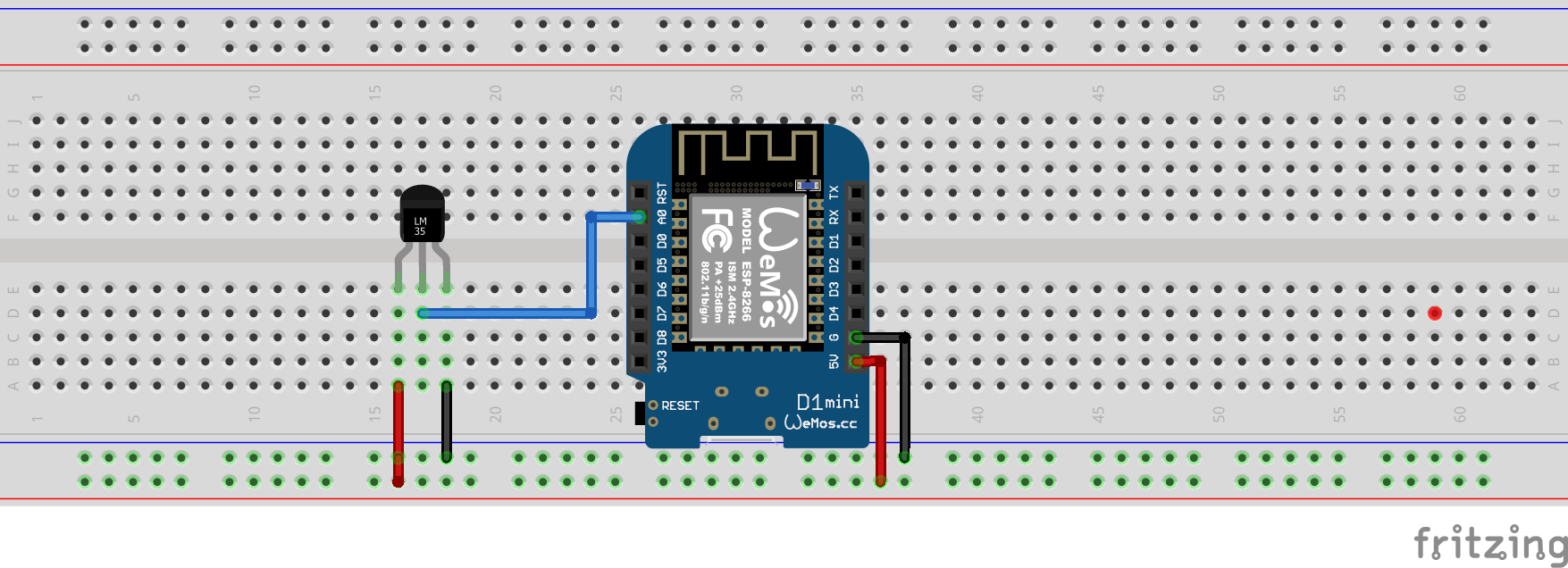
Wiring for LM35 or LM34 with ESP8266
Wiring for LM335 with ESP8266
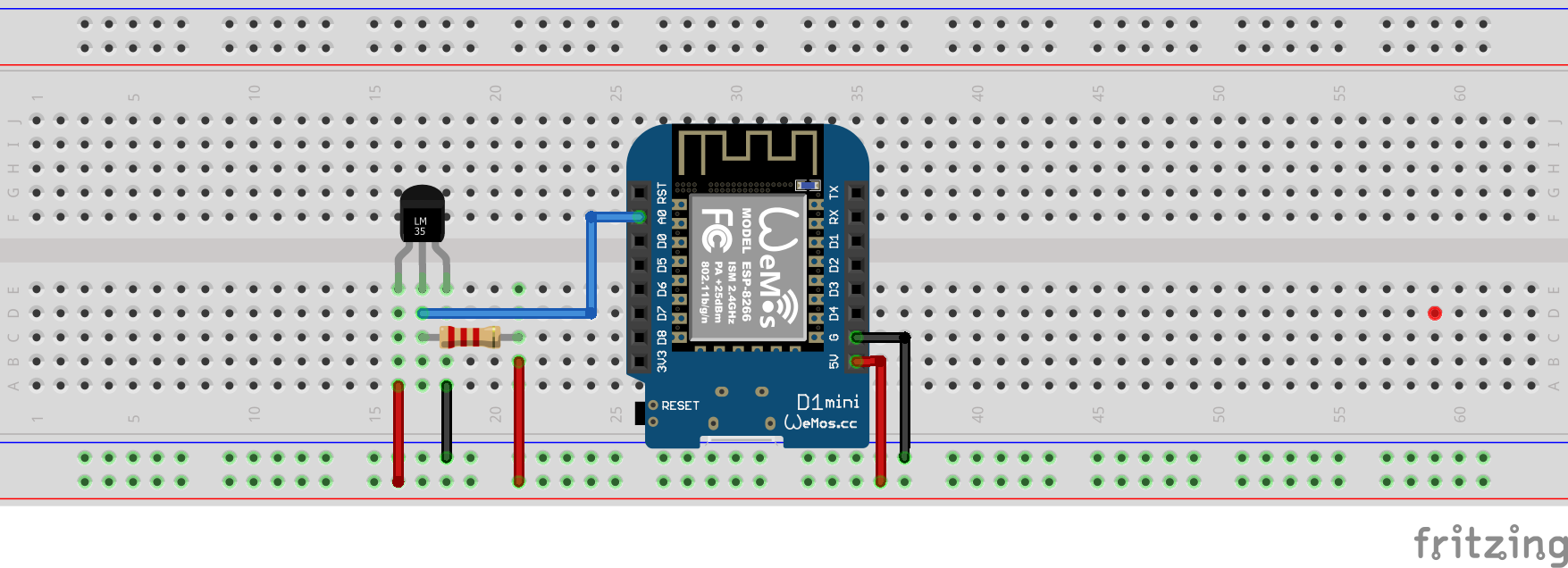
Pull-up via 2.2k Ohm resistor
| MCU | GPIO Pin |
|---|---|
| ESP32 | 36 (ADC0) |
| ESP8266 | A0 (ADC0) |
Let’s verify that temperature is wired correctly and working.
#if defined(ESP8266)
  #define LM_PIN    A0
#elif defined(ESP32)
  #define LM_PIN    36
#endif

#define ADC_VREF_mV    5000.0 // 5000 is the voltage provided by MCU. If you connect to 3V change to 3000
#define ADC_RESOLUTION 4096.0

void setup() {
  Serial.begin(9600);
}

float getTemperature() {
  #if defined(ESP8266)
    int analogValue = analogRead(LM_PIN);
    float millivolts = (analogValue / 1024.0) * ADC_VREF_mV;
    float temperature = millivolts / 10;
    // float fahrenheit = ((temperature * 9) / 5 + 32);
    return temperature;
  #elif defined(ESP32)
    int adcVal = analogRead(LM_PIN);
    float milliVolt = adcVal * (ADC_VREF_mV / ADC_RESOLUTION);
    float temperature = milliVolt / 10;
    return temperature;
  #endif
}

void loop()
{
  float temperature = getTemperature();
  Serial.printf("Temperature: %2.1f °C\r\n", temperature);
  delay(1000);
}
Step 1 : Create a new device in Sinric Pro
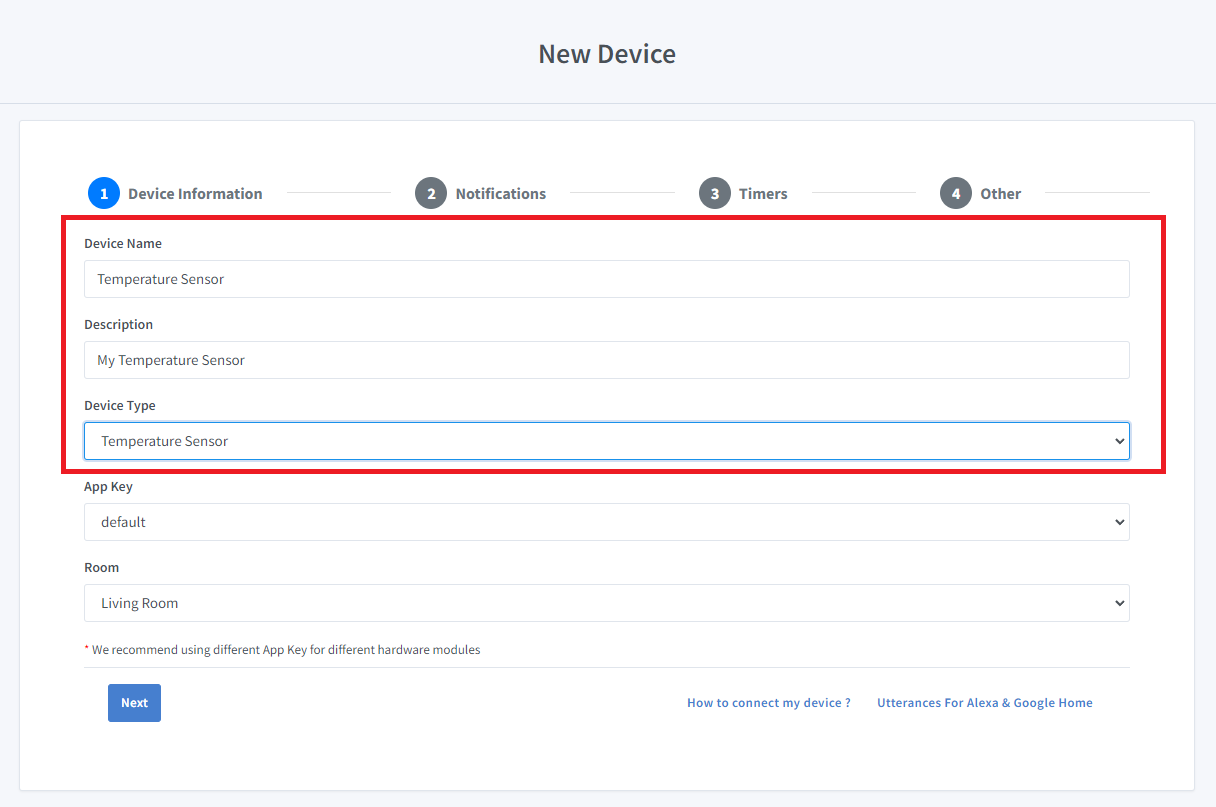
- Login to your Sinric Pro account, go to Devices menu on your left and click Add Device button (On top left).
- Enter the device name Temperature Sensor, description My Temperature Sensor and select the device type as Temperature Sensor.
- Click Next the in the Notifications tab
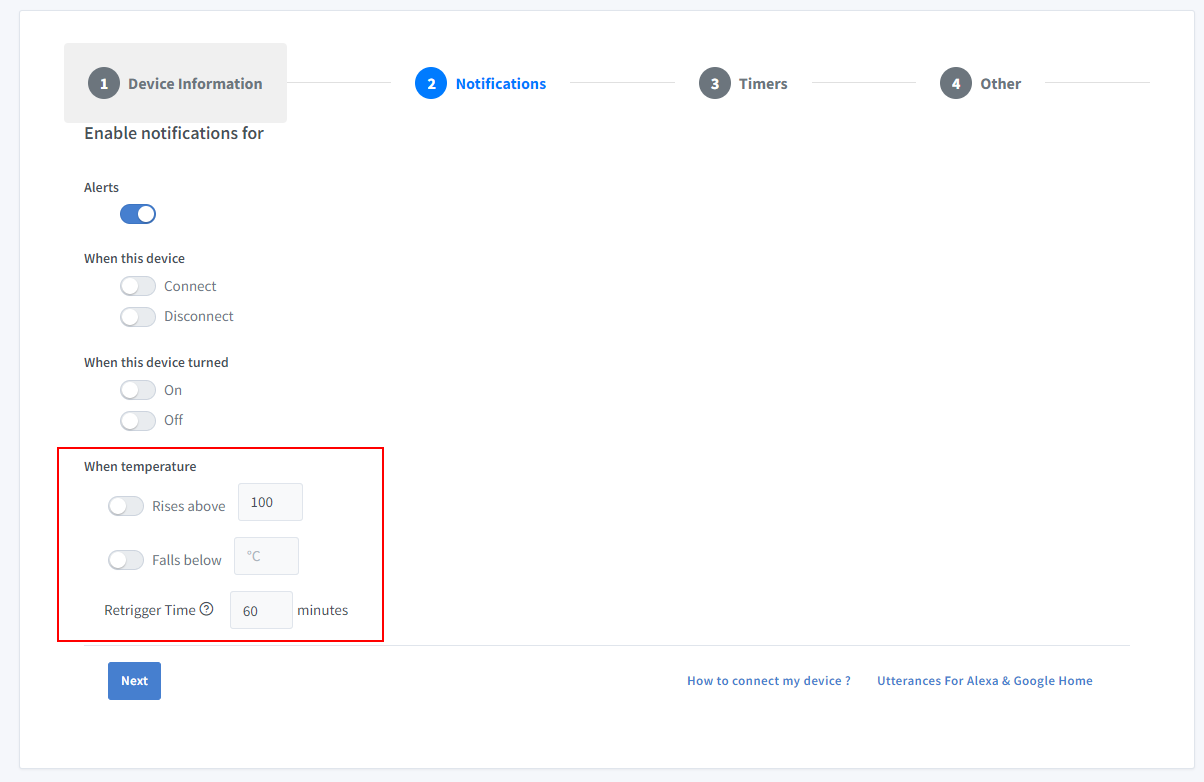
You can set the threshold here to receive a push notification via the Sinric Pro app when the temperature goes below or above a certain temperature. Use the Retrigger Time to set the delay between notifications.
-
Click Others tab and Click Save
-
Next screen will show the credentials required to connect the device you just created.
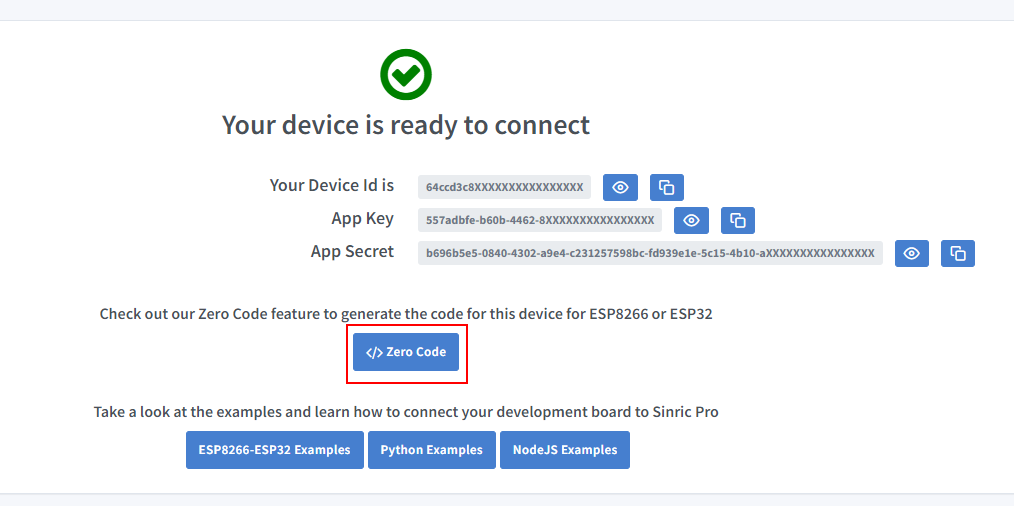
- Copy the Device Id, App Key and App Secret Keep these values secure. DO NOT SHARE THEM ON PUBLIC FORUMS !
Step 2 : Connect to Sinric Pro
Step 2.1 Install Sinric Pro Library
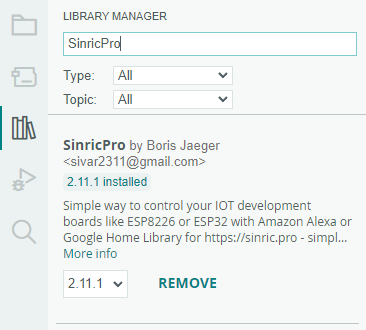
You can generate the code using Zero Code feature or write it by your self. If you do not have programming experice, we recommend to use Zero Code feature in the Portal to generate the code, download and flash.
2.2 Complete Code
#ifdef ENABLE_DEBUG
  #define DEBUG_ESP_PORT Serial
  #define NODEBUG_WEBSOCKETS
  #define NDEBUG
#endif

#include <Arduino.h>
#if defined(ESP8266)
  #include <ESP8266WiFi.h>
#elif defined(ESP32)
  #include <WiFi.h>
#endif

#if defined(ESP8266)
  #define LM_PIN    A0
#elif defined(ESP32)
  #define LM_PIN    36
#endif


#include "SinricPro.h"
#include "SinricProTemperaturesensor.h"

#define WIFI_SSID         ""   // Your WiFI SSID name
#define WIFI_PASS         ""   // Your WiFi Password.
#define APP_KEY           ""   // Should look like "de0bxxxx-1x3x-4x3x-ax2x-5dabxxxxxxxx" (Get it from Portal -> Secrets)
#define APP_SECRET        ""   // Should look like "5f36xxxx-x3x7-4x3x-xexe-e86724a9xxxx-4c4axxxx-3x3x-x5xe-x9x3-333d65xxxxxx" (Get it from Portal -> Secrets)
#define TEMP_SENSOR_ID    ""   // Should look like "5dc1564130xxxxxxxxxxxxxx" (Get it from Portal -> Devices)
#define BAUD_RATE         115200              // Change baudrate to your need (used for serial monitor)
#define EVENT_WAIT_TIME   60000               // send event every 60 seconds

float temperature;                            // actual temperature
float humidity;                               // actual humidity
float lastTemperature;                        // last known temperature (for compare)

#define ADC_VREF_mV    5000.0 // 5000 is the voltage provided by MCU. If you connect to 3V change to 3000
#define ADC_RESOLUTION 4096.0

float getTemperature() {
  #if defined(ESP8266)
    int analogValue = analogRead(LM_PIN);
    float millivolts = (analogValue / 1024.0) * ADC_VREF_mV;
    float temperature = millivolts / 10;
    // float fahrenheit = ((temperature * 9) / 5 + 32);
    return temperature;
  #elif defined(ESP32)
    int adcVal = analogRead(LM_PIN);
    float milliVolt = adcVal * (ADC_VREF_mV / ADC_RESOLUTION);
    float temperature = milliVolt / 10;
    return temperature;
  #endif
}

void handleTemperaturesensor() {
  if (SinricPro.isConnected() == false) {
    Serial.printf("Not connected to Sinric Pro...!\r\n");
    return;
  }

  static unsigned long last_millis;
  unsigned long        current_millis = millis();
  if (last_millis && current_millis - last_millis < EVENT_WAIT_TIME) return;
  last_millis = current_millis;

  float temperature = getTemperature();

  Serial.printf("Temperature: %2.1f °C\r\n", temperature);

  if (isnan(temperature)) { // reading failed...
    Serial.printf("reading failed!\r\n");  // print error message
    return;                                    // try again next time
  }

  if (temperature == lastTemperature) {
    Serial.printf("Temperature did not changed. do nothing...!\r\n");
    return;
  }

  SinricProTemperaturesensor &mySensor = SinricPro[TEMP_SENSOR_ID];  // get temperaturesensor device
  bool success = mySensor.sendTemperatureEvent(temperature, -1); // send event
  if (success) {
    Serial.printf("Sent!\r\n");
  } else {
    Serial.printf("Something went wrong...could not send Event to server!\r\n"); // Enable ENABLE_DEBUG to see why
  }

  lastTemperature = temperature;  // save actual temperature for next compare
}


// setup function for WiFi connection
void setupWiFi() {
  Serial.printf("\r\n[Wifi]: Connecting");

  #if defined(ESP8266)
    WiFi.setSleepMode(WIFI_NONE_SLEEP);
    WiFi.setAutoReconnect(true);
  #elif defined(ESP32)
    WiFi.setSleep(false);
    WiFi.setAutoReconnect(true);
  #endif

  WiFi.begin(WIFI_SSID, WIFI_PASS);

  while (WiFi.status() != WL_CONNECTED) {
    Serial.printf(".");
    delay(250);
  }
  IPAddress localIP = WiFi.localIP();
  Serial.printf("connected!\r\n[WiFi]: IP-Address is %d.%d.%d.%d\r\n", localIP[0], localIP[1], localIP[2], localIP[3]);
}

bool onPowerState(const String &deviceId, bool &state) {
  return true; // request handled properly
}

// setup function for SinricPro
void setupSinricPro() {
  // add device to SinricPro
  SinricProTemperaturesensor &mySensor = SinricPro[TEMP_SENSOR_ID];
  mySensor.onPowerState(onPowerState);

  // setup SinricPro
  SinricPro.onConnected([](){ Serial.printf("Connected to SinricPro\r\n"); });
  SinricPro.onDisconnected([](){ Serial.printf("Disconnected from SinricPro\r\n"); });
  //SinricPro.restoreDeviceStates(true); // Uncomment to restore the last known state from the server.
  SinricPro.begin(APP_KEY, APP_SECRET);
}

// main setup function
void setup() {
  Serial.begin(BAUD_RATE); Serial.printf("\r\n\r\n");

  setupWiFi();
  setupSinricPro();
}

void loop() {
  SinricPro.handle();
  handleTemperaturesensor();
}
Now you should be able to view the temperature via Sinric Pro App
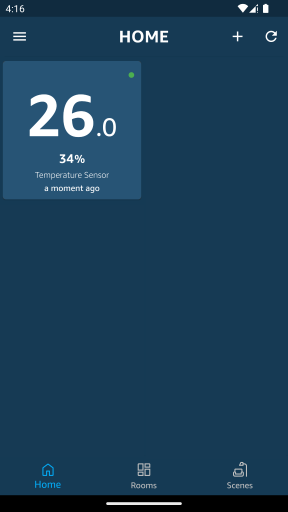
Please note that Google Home App shows the temperature sensor as a Thermostat due to Google Home limitations.
Troubleshooting
- Please refer to our Troubleshooting page for more details.
Related tutorials
- How to control an ESP32 or ESP8266 with Alexa and Google Home
- DHT11, DHT22, AM2302 temperature and humidity sensor
- DS18B20 temperature sensor
- BME280 temperature and humidity sensor
- BMP180 temperature sensor
This document is open source. See a typo? Please create an issue